Tuesday, March 31, 2015

Why I Do Long Runs By Myself

Every weekend in the winter and spring, hundreds of runners hit the Boston Marathon course for long runs. Along the way, they receive an inspiring amount of support--signs, impromptu water stops, cheering crowds and even cooperative cars.

I used to envy these runners. No one waited for me with water and a high five. Sometimes, I intentionally steered clear of the packs or waited until the afternoon, when I knew they’d be gone, in order to avoid all the hubbub.

Now, though, I happily coexist with the crowds, nodding and waving as I pass them. (For whatever reason, I often run in the opposite direction that they do.) In time, I’ve learned an important lesson: I like doing long runs by myself.

I think there are two key reasons why. First, for most of my life, running has been a solitary pursuit, a way to clear my head and, sappy as it sounds, figure out what matters. Long runs give me a lot of time to weigh the pros and cons of major decisions or simply sort through whatever may be causing me stress. Casual conversations with running buddies are great, but when push comes to shove, I need Beastwood Alone Time.

Second, I’ve come to realize that training should be tough.

I understand that support gets a lot of runners through the hell of three- or four-hour workouts (especially the folks I see training for Boston run who run for a greater reason than just running, which is certainly more than I can say for myself). I’m not one of them.

I understand that support helps mimic race-day conditions. I don’t want that. I want race-day conditions to be a veritable treat in contrast. Water stops? Awesome. Random strangers cheering and holding witty inspirational signs? Fantastic. Fuel in case I forgot / dropped my own? Outstanding.
Now, I’m not stupid. I fuel up before long runs, bring water on hot runs and track workouts and stick to well-traveled roads so I’m not far from help if anything goes awry. But when it comes time to run, I’m all business. No fuel, no unnecessary water, no human contact--just pushing myself to my limit, then pushing myself even further, all while thinkin’ ‘bout stuff.

Training should be tough because it makes you tough. Training should be tough because a marathon is next to friggin’ impossible, and if your mind, body and soul aren’t as tough as overcooked steak, there’s no way you’re going to finish the damn thing. Training should be tough because your race is a culmination of months of hard work, dedication, sweat, tears, protein shakes, stretching, eating, sleeping, fretting and pain--and if you survive all that, then, by God, you can make it through one race.

Does this make me crazy? (Crazier?) Probably. But I didn’t take my running to the next level by staying in my comfort zone. Odds are you won’t either.

Monday, March 16, 2015

7 tips for running in the rain

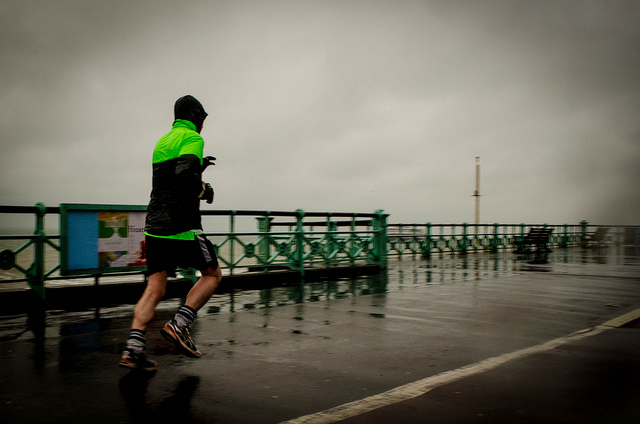
Saturday's long run took place in a slow but steady and cold rain. It reminded me of the Hartford Marathon, which occurred under similar circumstances (minus the snowbanks and ice). The morning of that race, I sat in my car, refusing to disrobe and check my bag until the last possible moment.

In the end, the weather didn't matter--I ran a marathon PR of 3:09:47. That, I realized, was precisely the point. Rain, like any other adverse weather, requires a different mindset than the ideal overcast, 50-degree day--but unlike blazing heat, bitter cold or blinding snow, I've learned from experience that rain can be easily overcome.

I didn't always feel that way. For years, I hated running in the rain. I'd postpone key workouts just to avoid the rain. (That's actually a bad idea: As Hartford proved, you never know when you'll face adverse conditions on race day. You need to train through bad weather.) I could get wet and dirty and disgusting in the snow, but not the rain. Don't ask me why; I have no idea.

Running a PR in Hartford definitely helped me overcome my general unwillingness to run in the rain--so much so that I didn't even bother checking the forecast on Saturday and didn't care when I started to get wet before I even got off the porch. Here's the approach I now take to running in the rain; hopefully my tips will help if you, too, fear the rain.


Dress down. I've mentioned before the general rule of thumb that you should try to dress as though this it's 15 to 20 degrees warmer than it actually is. This is especially important in the rain. At Hartford, most everyone else wore long-sleeve shirts and pants to stay warm. On the other hand, I wore a tank and shorts even though it wasn't even 50 degrees at gun time. I shivered on the line, and for the first several minutes of the race, but I didn't regret my wardrobe. Why? Less fabric to get soaking wet and therefore weigh you down.

Dress bright. If it's raining, the sun's not out. If the sun's not out, it's probably at least a little dark. If it's at least a little dark, cars may not see you. If cars may not see you, bad, bad things can happen. Don't let bad, bad things happen. Wear a bright shirt or a lightweight vest.

Get good socks. Contrary to popular belief, blisters don't need to be a rite of passage for runners. If you have good running socks, you can run through puddles all day long without getting blisters. These are expensive, yes, but you only need a few pair; I reserve them for race days, long runs and speed or tempo workouts when I know it will be wet.

Don't think about it. Easier said than done, I know, but you need to stop thinking about the rain. Remember, you'll be soaked after about 10 minutes anyway. After that, who cares how much more it rains?

Don't worry about puddles. Yes, you should try to avoid puddles; no one likes running with cold, wet feet. That said, see my previous point--you're going to be soaked after 10 minutes, and the same goes for your feet. If I have to choose between running through a puddle or flinging myself into traffic, I'll take the wet feet.

Be careful. A couple previous points touch on this, but it behooves you to be careful. It takes cars a little longer to stop and to see what's in front of them. Let the drivers win: Don't run in front of a car until you make eye contact with the driver and he or she either waves you on or cuts you off because he or she forgot the first lesson of driver's education or can't hit the brake and send a text message at the same time.

Do laundry ASAP, if not sooner. Everything I wore Saturday went into the wash once I'd showered and eaten. If you don't have enough laundry to constitute a full load, wash your clothes in the bathroom sink and hang them up to dry. At worst, find an out-of-the-way place to lay your clothes out to dry in the meantime. Your roommates/significant other/children/pets will thank you.

Thursday, March 12, 2015

The Renaissance of the Running Renaissance

The handful of you who read this regularly may (or may not) have noticed that it's been several months. Here's a quick update:

  • I ran a PR in the Hartford Marathon (3:09:47) even though it was pouring.
  • Five weeks later, I placed third in my age group at the South Shore Half.
  • I kept running throughout the holidays.
  • I ran my fastest 5K in years (19:17) on New Year's Day.
  • One month later, I got divorced and moved out.
  • We got seven feet of snow in three weeks, beginning on the first day of my 16-week training program for the Vermont City Marathon.
  • The snow cancelled a half marathon for which I had registered.
  • I caught a cold that has adamantly refused to go away.

I neither want nor expect a pity party. Plenty of people get divorced, and most didn't have as mutual and amicable a breakup as we did. (After our court appearance, we had lunch together.) Plenty of people suffered through the snow, and most didn't get to work from home every day. (Granted, it's because my office is several states away, and I always wok at home, but whatever.) Plenty of people missed training runs and got colds, and most didn't have the luxury of easing into training as I did. (I missed the first of five 20-mile training runs, yes, but I always miss the first of my 20-mile training runs.)

I bring this all up here because, truth be told, running got me through most of this. In the tenuous weeks before we finalized the divorce, my runs represented the only certainty in my life, the only time when I and I alone held control. I hadn't started training yet, so I had the luxury of tying my shoes, heading out the door and running as fast or as slow as I needed to. It cleared my head and reaffirmed why, for me, running is, above all, a beautifully cathartic experience.

After the divorce, and after my move, training forced me to focus. Rather than stare at the ceiling and wonder if my life would ever be normal again, I needed to figure out if that first slow-as-hell long run stemmed from nasty conditions or a genuine gap in my fitness level. (Answer: The former, thankfully.) Rather than write and rewrite an online dating profile, I needed to figure out how the hell I was going to do repeat 800s in 20-degree weather with all sidewalks and most roads still covered in a thick coating of snow. (Answer: On a side street, at midday, when no one's around, and with no expectation that you'll hit your goal pace.) Rather than eat junk food and drink beer, I needed to figure out how to cook enough food to feed myself after a long run using a two-burner electric cooktop, microwave, electric teakettle and convection oven. (Answer: Not all at the same time, unless you want to fumble with the circuit breaker in the dark basement.)

I still occasionally stare at the ceiling and drink beer, but I didn't create an online dating profile (suffice to say I haven't had to) or eat any junk food (because any world in which peanut-butter filled pretzel nuggets or maple creme cookies are considered junk is not a world I want to inhabit). That could change, but at the moment, I'm focused on training my ass off so I can run my ass off on Memorial Day weekend in Burlington, run another PR--and maybe, given my luck, qualify for Boston two and a half months before I join a new, slower age group. (Oh, yeah, I guess there's also work, and decorating my apartment, and figuring out just how many running shirts will fit in my new washing machine, and going on real dates for the first time since, well, ever.)

What's done is done. All I can do is move forward, one step at a time. Now that the snow and ice are finally gone, I can do it that much faster.

Tuesday, August 19, 2014

13 Things Smart Runners Do

In the midst of the Heartbreak Hill Half, as I plodded up another hill and did my best to keep the wheels from falling off, I got to thinking that running three races in 26 hours may not have been the smartest thing I’ve ever done.

That, in turn, got me thinking about something else: What exactly do smart runners do?

In the hours and days after the race, I came up with a list. Revisiting it weeks later, I see that everything’s still relevant. So here’s my (unscientific, as usual) take on the 13 things that smart runners do.

Wear the right shoes. Finding running shoes is a bit of an exercise in trial and error. Don’t be afraid to run a few laps around the store to test out shoes. (Heck, a good running store won’t let you leave if you haven’t run around in them.) This is especially true if, say, you’re wearing lightweight or minimalist shoes for the first time. Finally, check your shoe size periodically.

Cross train. To butcher The Shining, all run and no cross-train make Brian a dull and potentially injury-prone boy. Too much running will wear out your joints, while failing to strengthen your core will leave vulnerable parts of your body that you don’t realize are important to running until they hurt with every step you take. Make time for cross training now and your body will thank you later.

Check the weather, but don't obsess over it. Certain workouts are worth postponing if it’s too hot, humid or cold. Eventually, though, you have to suck it up, stop making excuses and get out there. If it means running for distance instead of time, or taking a bit longer to (literally, in this case) warm up, so be it.

Fuel properly. This matters less during the race than you think. (If you’re running for less than two hours, you realistically don’t need to refuel during the race, though it usually can’t hurt.) It matters more the morning of the race, the night before and the days before, as you take in good carbs and lean proteins that you know for a fact won’t upset your stomach and leave you in the PortaPotty line five minutes before gun time.

Hydrate properly, too. This, on the other hand, does matter during the race. Don’t let weather fool you -- even on cool, calm days, you’re sweating up a storm. The water stops are there for a reason. Get some electrolytes while you’re there, too. Oh, and don’t forget to drink up the day before the race.

Wear sunscreen. Here’s where you should check the weather. If the sun peeks out of the clouds during mile 3 of your marathon, and you didn’t bother to slather on sunscreen because it was cloudy at gun time, you’ll be sorry. Always wear sunscreen if it’s already sunny, too. (My advice: Get the stuff for kids, since it has a high SPF and is formulated to withstand sweat.)

Wear a hat. I wear a hat in the summer to keep my head from burning. More importantly, I wear a hat in the spring, fall and winter to retain heat. (I occasionally look ridiculous wearing a hat and gloves with short sleeves and shorts. I don’t care.) The bulk of the body heat you lose escapes through the top of your head. Keep it in and you’ll stay warm. (My advice, again: Invest in a couple good hats that will keep you warm without overheating your head and wash them frequently so they don’t stink.)

Study the course map. You’ll race better if you know where to turn, where to get water, when to expect a hill and when to begin your finishing kick (provided you have any gas left).

Devise a smart race strategy. If you know a race has more hills in its second half, start slow. If water stops aren’t plentiful, consider bringing some water along. If you aren’t in the best shape, don’t get disappointed if you don’t PR. If the race is far away, give yourself plenty of time to get loose beforehand (i.e. don’t jump out of the car and dash to the starting line). Above all, make sure you know where and when you’re getting your post-race grub.

Know when to say when. A friend had been looking forward to the Heartbreak Hill Half for weeks, but she woke up with a migraine on race day and opted to sit it out. As much as it sucks to skip a race, sometimes it’s not worth pushing it.

Learn from failure as well as success. My positive race memories have, over time, managed to blur together. My bad trips, though -- clinging to a telephone in my first marathon, bonking in my worst marathon, fading fast during a 10-mile race in 100-degree heat -- remain firmly in my mind. It’s not that I’m a helpless pessimist but, rather, that I’ve learned lessons from these experiences and (so far) haven’t repeated my mistakes.

Put Band-Aids on your nipples. See above r/e not repeating past mistakes.

Respect the road. You share the road with fellow pedestrians, bicyclists, skateboarders, cars, SUVs and trucks. Pay attention to them all. When in doubt, stop -- it’s much better to add 15 seconds to your run than to get cursed out by a biker or hit by a car.

I could probably think of more, but I started writing this two months ago, so it’s time to call it quits. Anyone have anything to add?

Tuesday, August 12, 2014

On Road Races That Aren't

Generally, I’m a running purist. I prefer running outdoors, I view my watch as a necessary evil and I choose races based on distance and location more so than who’s running or who’s sponsoring the post-race beer tent.

I increasingly find myself in a minority. Twitter explodes whenever there’s a race at Disney, and it seems clear that, for those runners, it’s less of a “race” and more of an experience, complete with mid-race pauses to pose for pictures. I also increasingly see friends signing up for Tough Mudder, Spartan, Electric Light and Color Runs, none of which describe themselves as races per se.

I’m honestly torn. The cantankerous side of me, the Statler or Waldorf (take your pick), sees it as a bit of a soulless way to take money from people who genuinely want to get into shape but aren’t motivated the same way that some of us are to train for and participate in no-frills road races, trail runs or triathlons with small crowds, little race support and no live band at the post-race party. (And take money they do: Those races are expensive. Buyer beware, too.) If I pay to run, I plan to run hard.

The optimistic side of me sees it as a refreshing way for people who genuinely want to get into shape but aren’t motivated the same way that some of us are to train for and participate in no-frills road races, trail runs or triathlons with small crowds, little race support and no live band at the post-race party to, you know, get in shape. The novelty of running doesn’t work for some people, but crawling through the mud, getting pelted with colorful powder or partying with an 80s cover band does.

I can’t say I’ll never run a Disney race. My wife and I vacation there often (she’s celiac, and it’s one of the few places she can eat without fear of a hospital visit), and one of our trips will inevitably coincide with one of the growing number of races in the Run Disney empire. (I also let my wife stay home when I race, since, let’s face it, the only thing more boring than running a road race is watching one, especially when your husband is a skinny white guy with dark hair wearing black shorts in a sea of thousands of skinny white guys with dark hair wearing black shorts, and a Disney race is arguably the only one that would entice my wife to tag along.) But will I actively seek out a Disney race? No.

I can’t say I’ll never run a novelty race, either. Right now, I have specific running goals. Sliding ass over teakettle down a muddy hill will ruin those plans. As I get older, and the odds of a road race PR drop to nil, who knows? But right now? No.

Heck, aside from some dollar-store garland handed to me a couple minutes before a Christmastime race a couple years ago, I’ve never even run in costume. I show up, get my bib, sit in my car, tighten my shoes, toe the line, run my ass off, finish, take my medal, grab free food and drink, stop for coffee, and head home.

That’s the way I’ve run, for the most part, since high school. (I appreciated iced coffee less back then. So, so stupid.) It works pretty well for me -- and, judging from the folks I encounter at races, it works pretty well for a lot of people.

It doesn’t work well for everyone. In fact, for some, it doesn’t work at all. If sparkly bottoms or a picture with Mickey or a military-style obstacle course or rolling around in the mud motivate people to run, I see no reason to stop them. Sure, I think it’s silly, but I suppose that doing a road race just for the running part and not the social part seems silly to a lot of people, too.

Friday, August 8, 2014

Beating the Blah: 6 Ways to Conquer a Running Rut

There comes a point in every marathon training cycle when I stop, think and ask myself, “What the hell am I doing?” It usually happens when I reschedule key workouts because of weekend plans and/or insufficient sleep and find myself doing a long run on, say, a Tuesday morning two days behind schedule.

This time around, it happened this week. I’ve been doing pretty well, it turns out, hitting my pace goals in track work and exceeding them in my tempo runs. Running itself hadn’t worn me out. Everything else had -- the jobs, the yardwork, the ever-full summer social calendar. On Wednesday, collapsed in a heap on the couch, my wife turned to me and said, “You look half dead.”

The next morning, I dragged myself out of bed for a tempo run. I extended the warmup by half a mile, figuring I’d need it. Then, a funny thing happened: I hit my pace goal for the first three miles. When I missed it for the fourth mile, I came back stronger for the fifth and sixth, finishing 10 and 18 seconds faster than my goal. One run undid a week malaise.

Running ruts aren’t uncommon. The constant pounding of the pavement takes a mental, physical and emotional toll. Proper training takes months; anything lasting that long inevitably provides highs and lows, and running is no exception. Plus, no matter how much we hate to admit it, running can be boring.

Conquering a rut -- “breaking the blah,” as I (cleverly) decided to call this post -- can happen in one of several ways. I highlighted having a kickass tempo run because that’s what just happened to me, but five other things will do the trick:

Cross-training. When I travel for business, I leave the running shoes at home and bring my bathing suit instead. I’m a terrible swimmer, mind you, but I enjoy it, so it gives me something to look forward to amid the long days, forced networking events and long nights that turn running into a chore. I return home recharged and ready to get back to running. If you’re in a rut, try biking, swimming or even walking.

Running “naked.” I run without a watch on my first few runs after marathon recovery. By not worrying about distance, pace or time, I enjoy myself more. If all the numbers associated with running leave you feeling overwhelmed, leave the watch at home for an easy run.

Resting. Never underestimate the value of a good nap. My test of whether I’m too tired: If I lie down and start to drift to sleep within 15 minutes, I skip the run. Yes, there’s value in running when you’re tired, as it prepares you for those final miles of the marathon, but there’s a difference between “a little tired” and “passing out on the couch tired.”

Racing. My ruts either fall smack dab in the middle of training or, conversely, when I’m not training for anything. With no goal in sight, I begin to wonder if it’s all worth it. Nothing changes my mind more quickly than signing up for a race. (Hint: To give yourself no choice but to commit, run with a friend or a team. Better yet -- volunteer to organize post-race brunch.)

Pausing. If nothing else works, maybe it is, in fact, time for a break. I’ve never reached this point, so unfortunately I can’t tell you how long your break should be or what you should do to pump yourself up in the meantime. But running pros take breaks, so there can’t be any harm in doing it.

We love running, and the last place we want to be is stuck in a moment that we can’t get out of. If you get yourself together, though, you won’t be able to lace up those shoes again.

Wednesday, July 30, 2014

Remember, Every Day Is a Gift

I haven't posted in a while. It's not for lack of effort -- I have four half-finished posts sitting in Google Drive -- but for lack of passion. Blame the heat and humidity, or the fatigue of the first weeks of marathon training, or the need to get over a proverbial hump at work. Whatever it is, I haven't felt like finishing the posts I've started. 

I'll get to them in due time. Today, though, it's time for a quick reminder to cherish what you have. 

Today I returned from Chicago, where I helped a good friend say goodbye to his brother. Earlier this year, he lost his father. How he's holding it together I can't even imagine. Another friend lost his father this spring, roughly one month before he got married. A third friend lost her dad as well.

I thought of this on last week’s run in the heat and humidity, plodding uphill a few seconds slower than my goal tempo pace. Life, health and happiness matter much, much more than any bad workout, bad day at the office, bad commute, bad customer service experience or bad argument. 

So take that three-day weekend. Give your pet that chin scratch. Watch that silly sci-fi movie. Have dinner with your friends. Call your parents. Run that race. Wear that audacious shirt. Blast that cheesy ballad. Compliment a stranger. Leave the chores for another day and have a date night. Do what makes you happy (provided you're not endangering yourself or anyone else). You never know when you won't have that chance any more.

Friday, June 13, 2014

Heartbreak Hill Half Recap: Three Races, Two Days, Six Lessons

Trying new things keeps life exciting. Running is no exception. I've been running close to two decades, but I'd never raced more than once in one weekend. So when Runner's World announced the Heartbreak Hill Half, offering the chance to do a 5K and 10K one day, and a half the next -- and to meet the magazine's staff -- I decided to give it a shot. (The 20-minute drive and the familiar course didn't hurt, either.)

To cut to the chase, I ran pretty well, with the exception of the last three miles of the half (not unexpectedly), and I enjoyed the experience, which was as much a festival as a series of races. I also learned a few things about racing more than once in a weekend.

Take it easy. The 5K came first, as it often does on a race festival weekend. I usually throw caution to the wind in a 5K -- at this point in my life, it's essentially a sprint for me -- but about a mile into this one, I knew I needed to hold back a bit if I wanted to make it to Sunday. I ran 20:06, which is quick for me without pushing it. (I ran my 5K PR when I was 17 and have accepted that I will never come close again.)

Study the course. Thanks to a friend, I knew the second half of the out-and-back 10K course had more hills. That, combined with the need to conserve energy, led me to take the first half of this race easy and push it a bit in the second half. It worked: Despite the hills, I ran negative splits. My 43:15 left me about 90 seconds short of a PR -- I ran my PR in an April race on a course that doesn't include Heartbreak Hill -- but this was still my best race of the weekend.

When in doubt, skip the fuel. I ate a granola bar about an hour or so before the 5K, which started 75 minutes before the 10K. Between races I ate nothing and drank a bottle of water. I saw folks who were running both races eating a bagel in between. My educated guess: They regretted it. Yes, 9.3 miles is a lot, but you shouldn't need to refuel if you run that distance -- and if you do, it shouldn't be a giant lump of carbohydrates, even if it's free. If you do need fuel, opt for a sports drink, gel or banana -- provided you’ve used that type of fuel before and know it doesn’t do funky things to your gastrointestinal system.

Look for shade. It was a good 10 degrees warmer on Sunday, and with more sun, than Saturday. Not a day for PRs. (Unless you're my aforementioned friend, who did it in the half AND the 10K -- and on the opening weekend of a community theater production of Hamlet. Clearly I'm an underachiever.) It was a day, though, to find the shade wherever I could out on the course and drink plenty of water (not to mention dump some on my head). My 1:33:12 half was several minutes off a PR, but, in a race that felt like a war of attrition, I was far from the only one to miss his or her best time.

Take it in stride. An event such as the Heartbreak Hill Half is less about racing and more about running -- pounding the pavement, meeting fellow runners and celebrating the sport we all know and love. You can't expect to excel at all the races of a festival weekend. Focus on one -- you can decide which one at the last minute, or even after you’ve started, as I did -- and use the others as faster-than-usual training runs with water stops and cheering crowds and tables of free food and drink at the end.

Pack extra clothes. You may not necessarily need to change after your first race of the day, but you most certainly will after the second. (I’m not sure, but I believe protocol allows you to wear the race shirt once you’ve collected your medal.) If you think you might change shirts, consider pinning your bib to your shorts (which you’re less likely to change, I imagine) so officials, volunteers and the like can verify that you did, in fact, run.

Complete more than one race in a weekend, and most of your friends and family will (continue to) think you are a little nuts. In the grand scheme of things, though, it’s not that difficult or painful -- certainly not in comparison to a marathon -- and the swag, the compliments and the sense of accomplishment make it all worth the effort. If you’re up for the challenge, you’re healthy and you’re willing, I say you give it a shot.

Tuesday, May 27, 2014

What I Learned From the Maine Coast Marathon

I signed up for the Maine Coast Marathon several months ago, knowing full well the race would be sandwiched between two weddings on opposite coasts. I figured I could pull it off pretty easily -- the trip to San Francisco was one week before the race, amid my taper, and the trip to Disney World three days after the race would offer a nice recovery opportunity. (For the uninitiated, a typical day at Disney requires several miles of walking.) 

For the most part, I did pull it off. I fell short of my lofty goal (a BQ of 3:05) and my more realistic goal (a PR under 3:13), but I ran the race I wanted, for the most part. I'd planned to run negative splits, starting with 7:20s and finishing with sub-6:50s en route to that BQ. This worked well -- that is, up until Mile 19 or so, when the sun, the heat and the pace starting to take their toll. (Any other year, 70-degree temperatures might have been bearable, but after training through the Polar Vortex, not so much.) 

My finishing time, 3:16:15, ranks as my third or fourth best. (I can't remember, really.) I'm still several minutes faster than I was at 21, which is great, and more than half an hour faster than my worst marathon, so I really can't complain. 

Of course, there's a lesson here. I concocted my negative split plan a whopping two weeks before race day. (Great idea, Beastwood.) This means I did none of my long runs as progression runs, which means I wasn't physically prepared to run faster deeper into the race. I thought I was, of course, having made easy work of my tempo runs, often exceeding my target paces by 15 seconds per mile. It takes more than two weeks -- and two weeks of taper at that -- to prepare yourself for a race strategy that you've never employed.

That said, I got the hard part of the marathon right: I started slowly, stayed that way and kept to my target paces for three-quarters of the race. Next time, I'll set less ambitious splits -- and, more importantly, I'll train for those negative splits from the beginning. Setting goals is important, after all, and now I have two clear-cut ones for training for marathon #11. Now, about that sunshine...

Friday, April 4, 2014

11 Ways Running Gets Easier As You Get Older

Last week, I wrote about 11 reasons running gets harder as you get older. I got quite a bit of feedback, much along the lines of “glad I’m not the only one.”

In that post, I also promised to follow up with ways running gets easier as you get older. I’ve been running since 15, so I’d like to think I’ve picked up a lesson or two -- or, in this case, 11, along the way. (Note: As before, these are completely unscientific, just anecdotal.)
  1. You know your legs better. This is probably the most important point of all. You know the difference between “I can keep running” pain, “I need to slow down” pain, “I need to walk” pain and “I need to collapse on the side of the road” pain. This can’t prevent injuries entirely, but it can help keep them from getting serious. 
  2. Your know your body better. This is different than the first point. When I was younger, I often pushed myself to the point of exhaustion. Sometimes it worked, but it often didn’t -- my high school team always seemed to peak in the middle of the season, not at the end. As I’ve aged, I’ve come to discover the difference between being genuinely fatigued (in which case I take a day off, or at the very least a nap) and simply tired (in which case I suck it up). 
  3. You know yourself better. If 90 percent of baseball is half mental, I’d be willing to bet 90 percent of running is all mental. When you’re just getting started, you question yourself at every turn -- about the distance you’re running, the clothes you’re wearing, the goal you’re setting and so on. Over time, these doubts subside, and you’re increasingly able to trust your training -- and yourself. 
  4. Passing people younger than you at the end of a race is far more embarrassing for the passee than when it's the other way around.
  5. You’ve experienced disappointment, whether through running or life itself. By now, we’ve all bonked a race -- or an exam, job interview, first date, home improvement project, sales presentation or heaven knows what else. Needing to skip a workout or missing a race goal no longer induces panic. 
  6. You know how to set goals. Scott Fishman suggests setting three goals before a race, paraphrased here as the ideal, nothing-goes-wrong goal, the realistic goal based on your fitness level and the everything-hurts-and-wait-is-that-snow? goal. I nodded many times as I read Fishman’s post. Anyone who’s been running for a while knows that roughly 10 million things can affect how you run on any given day, so setting a single (often lofty) goal is shortsighted and counter-intuitive. 
  7. You really can eat whatever the heck you want. Within reason, of course; I embrace a pretty healthy diet. But the amount of food I consume in a single sitting, especially in the midst of marathon training, literally frightens the uninitiated. 
  8. You can afford it. Yes, running is a relatively inexpensive sport, but to do it right -- with the proper shoes, clothes, watch and other equipment -- you do need to spend a bit more cold, hard cash than you likely had back when you drove a crappy car and lived in a crappy apartment with crappy roommates.  Plus, what’s the fun of running without racing every once in a while? 
  9. You’ve accepted who you are. I am not a before-the-crack-of-dawn runner, so I’ve all but given up trying to wake up while it’s dark out to run. It took many years, and many failed attempts to run early in the morning, to realize this. I don’t plan for morning runs (unless I’m racing, of course) and therefore can’t feel bad about missing them. 
  10. You can help others. As I get older, more friends take up running. Many have questions -- about shoes, pain, speed, racing and so on. Having been around the block, I can (and happily do) offer advice when and where appropriate. Really, it’s the least I can do. 
  11. Above all, you’re not an idiot. Once, after a bad high school cross country race, I decided to punish myself and do my cooldown barefoot. That was pretty freakin’ dumb. 
Having outlined how running is both worse and better when you’re older, I’ve decided to take some time and think about an answer to the question that these two posts have sparked: Is running more fun when you’re younger or older?

Friday, March 28, 2014

11 Ways Running Gets Harder As You Get Older

On a recent run, as I learned the hard way that 90 minutes between eating and running apparently is no longer sufficient, I came to realize that running gets harder as you get older. Naturally, a few miles later, I felt fantastic and was convinced that running actually gets easier as you get older.

Both statements are true. Certain aspects of running improve with age; others, not so much. This post will focus on how (and why) running gets harder as you get older. I’ll cover the positive stuff in a subsequent post. (Note: None of this is actually scientific.)

  1. You need rest. This comes in two forms: Sleep and days off. In my 20s, I could party into the wee hours of the morning, wake up a few hours later, and run a PR. You probably could, too. Now? Hangovers last two days. Forget it.
  2. You need to stretch constantly. Did you stretch after every workout in high school? Didn’t think so. Now, if you don’t stretch before you get into bed, it’s highly unlikely you’ll be able to get out of it the next morning. In fact, you should probably be stretching right now.
  3. Everything hurts. Even when you rest, stretch and foam roll, you’re sore. You can’t complain about it, either, because then everyone will just tell you to stop running.
  4. You need more downtime. As a result of everything described above, I usually need at least one day off after a hard workout -- sometimes two days.Same goes for bouncing back from races.
  5. Life gets in the way. You have a real job, real relationships, a home you actually care about keeping clean, a car that you don’t always want to smell like wet running shoes, pets, children, in-laws, school and 47 million other things to get in the way of training. This means running in the morning when you're tired, running at night when you're tired or running in the middle of the day when you're tired. Awesome.
  6. Your GI system gets sensitive. Back in the day, I used to eat dinner and run 45 minutes later. That was fun. Now my body apparently needs two hours to process a banana and some yogurt.
  7. You have to watch what you eat. Sure, publicly we brag about eating “whatever we want,” but privately we carefully measure out portions of proteins, carbs, fat and water so we don’t gain or lose too much weight. It’s a far cry from literally eating whatever we wanted while we ran in high school and college.
  8. You have to pee more. Didn’t wait in those pre-race PortaPotty lines in the halcyon days of your youth, did you? And just reading about having to pee made you have to pee, didn’t it?
  9. It’s more complicated. I started running in 1995. It took six years for me to even buy a watch. Now I wear a GPS-enabled watch that tracks distance, pace and time and input that data to a website that lets me track every workout. Oh, and then there are the shoes….
  10. It’s too hot. Now it’s too cold. Sensitivity to temperature only increases as you age. The days of wearing only shorts and a long-sleeve T-shirt on a 30-degree day are long gone.
  11. You never have leftovers. After running for more than 18 years, I need such ridiculous amounts of food to fuel my metabolism that I never get a doggie bag from restaurants, I need to cook for four if I want leftovers at dinner, and friends and family gawk whenever I eat.
I’m sure there are more than 11 ways running gets harder as you get older, but these are the ones that came to mind immediately. What did I miss?

Monday, March 10, 2014

Running in the Dark: Another Cautionary Tale

When you get down to it, you try to avoid two things when running in the dark: Falling down and getting hit by a car. (Yes, you try to avoid these things running in sunlight, too, but darkness magnifies the difficulty of the tasks.)

Earlier this winter, I offered a cautionary tale about what can happen on even your most familiar running routes. I let my guard down for a second, and I fell down.

Getting hit by a car also happens when you, or the driver of the car, let your guard down for a second. Obviously, you should pay attention at every intersection and street crossing, erring on the side of caution. Most people are lousy drivers, after all.

Now, you can't control how other people will drive, but you can control how you appear to them. One way to make sure drivers see you is to dress like this:


I hit most of the colors of the rainbow here: Red shoes, blue hat, green shirt, yellow vest, black tights and pasty white skin. And this doesn't even include my headlamp, which I put on after snapping this pic when I realized how dark it was outside.

Do I have any evidence that, had I dressed otherwise, a car would have hit me? No. But I imagine I was pretty hard to miss.

Saturday, March 8, 2014

Don't Be Afraid to Run Naked (At the Wrist, That Is)

At my day job, covering technology, there’s a lot of talk about fitness apps and fitness gadgets and wearable tech and, in the context of healthcare, the quantified self. (Full disclosure: I contributed to the hype by creating a list of tech for the athletes on your Christmas list. To further prove I am a sellout, I made it a slideshow, too.)

There’s definitely value in tracking all this data. When you’re training, you need to make sure you’re hitting the right pace and distance -- and, frankly, it’s much easier to log that information and study it later if it comes from a fancy watch or smartphone. (Full disclosure, again, which makes sense since I put "naked" in the headline: I track my runs using dailymile.)

However, there’s also a downside to having so much data. It’s easy to fret over, especially when targets are missed. It doesn’t take into account that, say, your tempo run in 22-degree weather on snow- and ice-covered sidewalks couldn’t possibly happen at goal pace (as has been the case so often this winter). It’s not just times, too; steps taken in a day, miles run in a month, weight lost (or gained) or other numbers can quickly become obsessions -- and the problem can be further exacerbated when all this information gets shared on social media sites.

I fully recognize the benefit to aggregating and sharing this information. If you've started, and especially if you've started as a means of motivation, there's no point in returning to the 20th century and "guessing" how far, fast and long you've run.

Every once in a while, though, it pays to unplug. On an easy day, the watch stays home. On the first few runs after my post-marathon rest, the watch stays home. On days when the weather's terrible, and pace goals go out the window, the watch stays home (or freezes). On a rushed race day, the watch (often accidentally) stays home.

Running unplugged offers a few benefits. It helps to run "by feel," without constantly staring at your watch. It prepares you for situations when your watch fails you. It lets you clear your head, since you're not focusing on every little detail of your run. It lets you enjoy the scenery. It lets you return to your roots, to the freedom of running around your backyard or park for hours as a child, and appreciate our sport even more.

It certainly isn't easy. Like any routine, running with a watch is a hard habit to break. But if you have an easy run in your future, it might be worth leaving the watch behind and just seeing what happens.

Who knows? It just might be the start of a new routine.

Monday, February 10, 2014

It's Not Where You Start, It's Where You Finish

Near the beginning of the Super Sunday 5, during the period when everyone is either heading to the start line or waiting for a vacant bathroom, the race announcer said something over the loudspeaker that, in my years of racing, I’ve never heard before. 

As everyone staked a claim to a small patch of asphalt that, for the next few minutes, would belong to nobody else, the announcer made the usual remark that slower runners should move farther back. Then, to assuage everyone’s fears, he added, “The race isn’t won in the first 100 meters.” 

For someone with a nasty habit of starting races like a bat out of hell, this stuck with me -- especially since, as the crowd gathered, the blue-and-orange START banner seemed to get farther and farther away. 


I lamented about getting boxed in at the start several months ago, in my James Joyce Ramble recap. Back then, I chalked it up to a lack of confidence; I’d bonked badly in a marathon a few months before and remained on the proverbial comeback trail. 

This weekend, though, I directed my ire toward the runners gathering around me. Perhaps I was jealous that they’d located their friends and exchanged pleasantries while I stared ahead in solitude. Perhaps I was a bit chilly. Perhaps their perfectly matching outfits turned me off. Whatever it was, I wanted them gone -- even though, like me, they’d paid to run a race with the express mission of raising money to kick cancer’s ass. 

My ire continued after the gun, when the murderous, thieving horde of peasants refused to part like the Red Sea so I could get to the front of the pack. And it continued when I passed the 1-mile mark about 20 seconds slower than my goal pace, even after adjusting for the gun vs. chip time split. (I also left my watch at home. That may have contributed to my mood.) 

Then a funny thing happened: I got stronger. I wasn’t gassed from an unnecessarily fast start. The gradual hills that lead into Harvard Square didn’t bother me. I didn’t start losing ground to folks who had started even farther back. I actually maintained a constant pace for the duration of the race and finished with the same 5-mile time I ran back in April on a flatter course. 

Sure, I didn’t PR, but I’ve accepted that I can’t PR all the time. (I ran a sub-30 minute 5-miler back in college. That’s never happening again.) I also learned that, sure enough, you don’t win a 5-mile race in the first 100 meters. Finally, I was reminded that it really doesn’t matter where you start but, rather, where you finish.